


Anglers Booking Team
The expert copywriters at Anglers Booking have meticulously crafted this article. Our dedicated team of writers provides valuable insights and information to enhance your angling experience.
 10 minutes read
Today, under our radar, is one of the most prized catches in saltwater fishing, the Red Snapper. To uncover the best lures for this powerful fish, we'll break down everything you need to know.

Red Snapper are smart, selective, and scent-driven predators. Between tides, structure, and presentation, small details matter.
In this guide, you'll learn why choosing an effective lure is essential. Additionally, expert tips for fishing near reefs, wrecks, and other underwater structures are also included. So don't waste any time, let's go!
Before we start to discuss the most effective lures, one thing is necessary. It is about understanding Red Snapper. The more you know about them, the greater your chances of successful fishing are.

Red Snapper are smart and at the same time cautious. They don't strike mindlessly. They often wait near a structure to ambush prey. They eat small fish, shrimp, squid, and crabs. Also, their diet may include plankton and small invertebrates.
Red Snapper likes warm waters with hard or rocky bottoms. They often stay near reefs, oil rigs, and shipwrecks. Adults live in deeper water, at depths of 30 to 200 feet. Some live even deeper, up to 620 feet.
Young fish stay in shallow areas with sand or shells, often near the shore or in estuaries. Red Snapper likes to stay in one spot. They don't move far if they find a good structure.

Red Snapper feed year-round. However, some seasons are better for fishing. Water temperature, spawning, and fishing pressure all affect their behavior.
Just follow the tips from above, and you are on the right track to have success in fishing. In the part below, we analyze the best places where you can find this fish.

To catch Red Snapper, you need to know where they live. These fish love structure and cover. If you carefully read the part below, you can easily pick the best spot and the effective lure.
Knowing where to find Red Snapper and how they behave in each spot can change your fishing game. Match your lures to the location, and fish with care near the structure. Use this guide to find them, tempt them, and hook more fish.
Live bait is often the top choice for Red Snapper. However, lures can closely imitate their natural prey. Sometimes they can even work better. They are also more practical because they last longer and are easier to carry. Using an effective lure can make your Snapper fishing more successful.
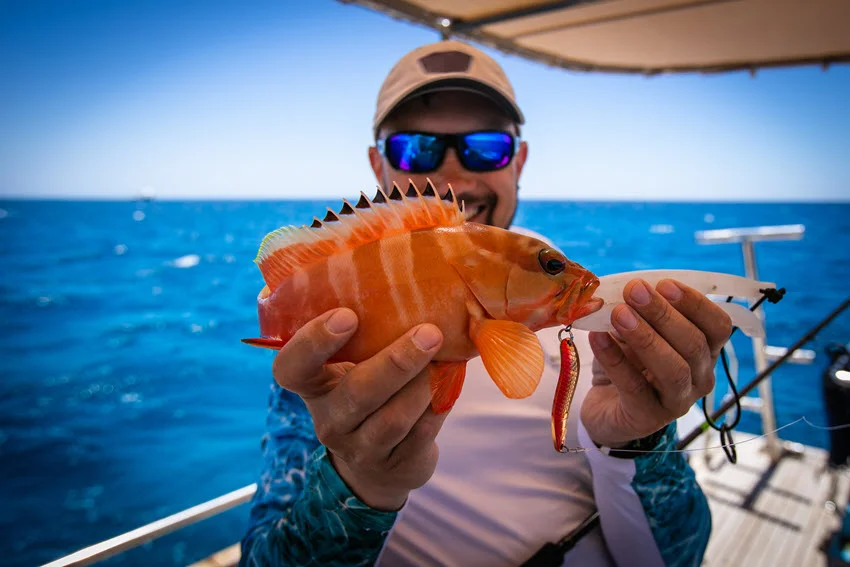
Soft plastics are very effective and widely used by anglers. They mimic the appearance of small fish, squid, or shrimp. They are effective in natural colors. Try white, pink, or silver that match local prey. For optimal action, rig them on a jig head or use a Texas rig to achieve realistic movement and better control.
These lures work well when cast and retrieved near reefs and wrecks. Let them bounce along the bottom to imitate injured prey. They are especially effective in the spring.

Bucktail jigs are classic lures that work well in a variety of water depths. Their natural-looking shape and pulsating action attract Red Snapper easily. For extra appeal, you can tip the jig with a small piece of bait or a soft plastic to add scent.
Use bucktail jigs near reefs, ledges, and wrecks. Drop the jig to the bottom and bounce it up and down to imitate wounded prey. Bright colors, such as chartreuse, red, or white, are more visible in murky water, while natural colors work best in clear water.

Metal jigs are ideal for fishing in deeper and darker waters. They sink quickly and mimic the fluttering movement of scared or injured baitfish. The standard technique for metal jigs is vertical jigging. Lift sharply, then lower slowly to create a flutter that attracts Red Snapper.
These jigs are very effective around ledges and oil rigs. Depending on the depth and current, choose weights between 1 and 4 ounces to reach the fish easily.

Crankbaits are often underrated but excellent for Red Snapper, especially in shallow, inshore waters. They imitate small fish, which Red Snapper love to eat, and they can dive to the needed depth quickly.
Stick to natural colors such as silver, gold, or green. All of them are effective. These lures work best in spring and summer when Red Snapper are more active and hunting in shallower water.

Squid is a typical Red Snapper food, so rubber squid lures are very effective. Their tentacles flutter naturally in water, making them very realistic. Use these on a jig head or drop-shot rig. Let the lure sink to the bottom, then retrieve it slowly with a jerky motion to imitate the movement of a real squid.
These lures work well near reefs, wrecks, and rocky areas. They come in different colors; however, pink, orange, or glow-in-the-dark are most effective in low-light conditions.
Red Snapper feed primarily near the bottom around reefs, wrecks, and underwater structures. To catch them with lures, use methods that let you present your gear close to the fish's feeding zone. These techniques blend action, position, and targeting to hook more Red Snapper on artificial lures.

This isn't just bait; it works excellently with lures, too. Drop a heavy jig or a soft plastic bait down to the structure, pitch it just above the rocks or wreck, and let it hover. Red Snapper often strike on the fall or slow retrieve. A rig like this gives precise placement and works well when fish feed along the bottom.

Drift fishing uses the boat's movement to carry your lure over different depths and features. Cast a jig or lure upstream of the structure. Let it sink, then let it drift naturally. Methods like this cover more ground and find fish across reefs and ledges. Watch your line, Red Snapper bites can be subtle!

Slow-pitch jigging is highly effective in deeper water. Drop a metal jig or weighted lure straight down over the structure. Make short upward twitches, then pause and let the lure flutter down. That motion triggers aggressive strikes from bottom-hiding Red Snapper.

Combine chumming (small bits of bait) with lure fishing. Scatter chunks of fish throughout your area to attract Red Snapper. When the scent attracts them close, drop a jig or soft plastic to the bottom. Let the fish settle, and then, retreat slowly to resemble injured prey.

Sometimes, casting is best. If you're near shallow reefs or rubbly ledges, cast a vibrating lure or soft plastic ahead of the structure. Let it sink. Then work it back slowly using hops, pauses, or slow-roll retrieves to attract Red Snapper when they are actively feeding along edges.

Understanding fishing regulations and ethical practices about specific fish species protects fish populations and ecosystems and promotes responsible angling practices.
Anglers Booking Team
In most areas, strict regulations are in place. These often include bag limits (the number of fish you can keep), size limits (the minimum size of the fish), and seasonal closures (periods when fishing is not permitted).
In the U.S., Red Snapper regulations are managed by NOAA Fisheries. They monitor Red Snapper stocks and adjust rules as needed to protect the species. You can find updated regulations on their official website. Ethical fishing is just as important as following the law. Use circle hooks to reduce injury when releasing fish. These hooks help prevent deep hooking and increase survival rates.
Also, respect the ocean. Never leave fishing lines, hooks, or trash behind. Pick up after yourself, and give other anglers space to fish. Keeping the water clean helps all species and ensures strong Red Snapper fishing for the future.
Catching Red Snapper requires more than luck. It is important to match the lure that you use to the water conditions. Additionally, employing the right strategy is a great way to achieve successful fishing. Red Snapper fishing requires skill and patience!
And what lure do you use the most often for Red Snapper fishing? Which one was the most successful according to your experiences? We are happy to see your answers in the comments.

The expert copywriters at Anglers Booking have meticulously crafted this article. Our dedicated team of writers provides valuable insights and information to enhance your angling experience.
September 12, 2026
October 11, 2025
Subscribe to our newsletter and receive a selection of cool articles every week.
Embark on unforgettable fishing adventures with us at Anglers Booking.
book your charter
October 2, 2026
September 8, 2026
August 21, 2026
August 18, 2026
August 15, 2026
August 12, 2026
August 8, 2026
August 4, 2026

You're now part of our exclusive community. Get ready for premium content and updates straight to your inbox.
close
Subscribe to our newsletter and receive a selection of cool articles every week.
Please enter a valid email address.
Be the first to know when we're back in action.
Please enter a valid email address.
Leave a Comment
Your email address will not be published. Required fields are marked *
Thank you for your comment! It has been submitted for review and will appear on the site shortly.