


Anglers Booking Team
The expert copywriters at Anglers Booking have meticulously crafted this article. Our dedicated team of writers provides valuable insights and information to enhance your angling experience.
 11 minutes read
Sunfish are a diverse and interesting group of freshwater fish. The word "Sunfish" can refer to both marine species (such as the ocean Sunfish) and the more familiar freshwater species (family Centrarchidae). In this article, we focus primarily on freshwater Sunfishes, which are common in ponds, lakes, and rivers.

Today, we will analyze the difference between the types of Sunfish. We will discuss their environment and recommend the best equipment and baits for them. So, let's get started from the basics below!

Sunfish (in the freshwater sense) belong mainly to the genus Lepomis and their relatives. There are many species (over 30 native species in North America) in the Sunfish family (Centrarchidae). In this text, we will describe several common species: Bluegill, Green Sunfish, Pumpkinseed, Redear or "Shellcracker", Redbreast Sunfish, and Warmouth.
Types of Sunfish are different. They have distinctive traits in body shape, fin structure, color, and behavior that help distinguish them. Because different species sometimes crossbreed, some individual fish may exhibit mixed characteristics. Sunfish are often small, colorful, and aggressive feeders.
Many anglers like them because they put up a fight on light tackle and are widely available. They are an essential part of ecosystems and are used in pond stocking. They tend to inhabit waters with cover (weed beds, submerged logs, brush, overhanging vegetation) because in such places they can find food and avoid predators.
Below are descriptions of a few of the most common freshwater Sunfish. For each, you'll get details about how to identify them, their typical size, where they tend to live, when they bite best, equipment recommendations, and preferred baits.
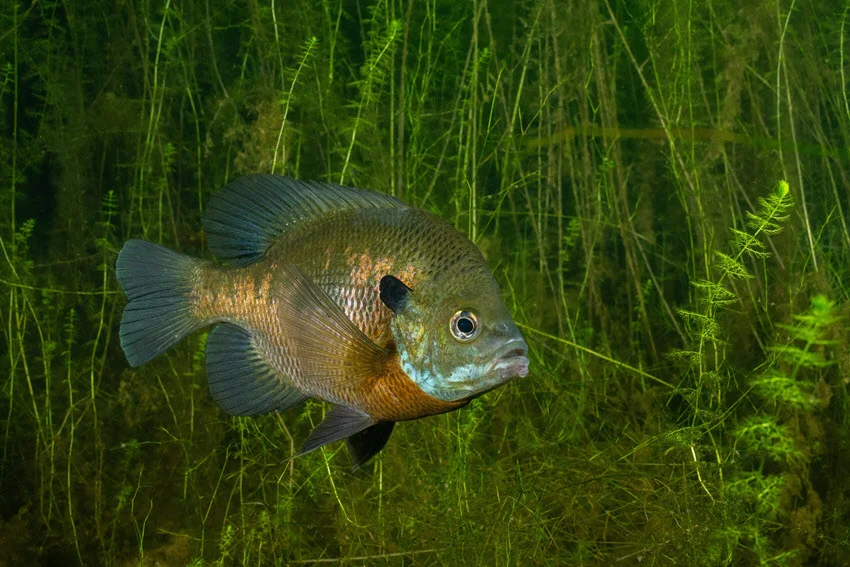
Bluegill have a deep, laterally compressed body shape (a "Panfish" look). Most anglers compare Bluegill and Crappie, due to their similar round bodies and small mouths, though the Bluegill's upper jaw does not extend past the eye. The sides often bear faint vertical bars, and the gill cover (opercle) has a dark spot at its rear edge. Their coloration is usually shades of blue, green, and bronze, with more vivid hues on males during breeding.
In terms of size, Bluegill commonly reach about 4 to 16 inches in length, and weights of 1 to 3 pounds are typical in good environments. These figures represent the usual size range for Bluegill, though exceptional specimens can occasionally exceed these measurements under optimal conditions.
Bluegill often inhabit shallow waters near cover, such as submerged vegetation, fallen branches, and docks. They also use shallow nesting areas during spawning (frequently 1 to 6 feet deep). In summer, they may move to slightly deeper water but often remain within 10 feet or less of structure or cover to stay safe and feed.
Florida offers some of the most productive fishing spots for this fish, such as Lake Okeechobee, Lake Kissimmee, Lake Panasoffkee, and the Withlacoochee River. Bluegill are also native to the central and eastern U.S., including the Mississippi, Missouri, and Ohio River basins.
Their peak season is late spring through summer (May to July) when water temperatures warm and spawning occurs. During those months, male Bluegill build nests and defend them, making them more aggressive and easier to catch.
Early morning is the best time to catch them. Late afternoon could also be productive. During these periods, fish feed actively in warmer surface layers, though midday can still produce bites near shade and cover.
Use light tackle: an ultralight rod (1 to 4-lb test line) or a light spinning rod is sufficient. The goal is to let the fish fight on light gear so you can enjoy the sport. Because Bluegill are relatively small, heavy gear will overpower the fight.
Use a small float (bobber) or just a light jig setup. A small hook (size 8 to 14) is appropriate because Bluegill have small mouths.
Bluegill often feed in shallow water, a few feet deep near cover. For the best Bluegill bait, anglers use live bait like worms, crickets, or small insects. With them, you can expect most success.
Also, use small jigs or soft plastics in shallow water near structure. An artificial lure can yield solid results, but live bait is best.
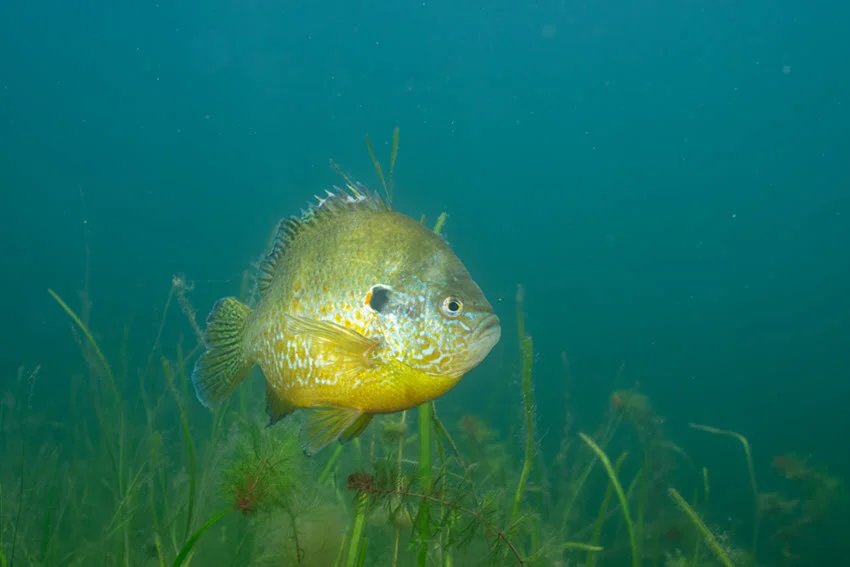
The Pumpkinseed Sunfish is more colorful and ornate than many other Sunfish. Its body is also deep and compressed, giving it a disc-like profile. The fish's sides show olive, yellow, blue, and orange tones, often with mottling or spots. A key feature is the opercular flap ("ear flap"), which in mature fish carries a red or orange crescent-shaped border edged by white.
Wavy lines of blue and turquoise often run across the face and cheek. In size, Pumpkinseeds commonly measure 4 to 6 inches in length in many waters, but can reach up to about 12 inches. Their usual weight is under 1 pound.
Pumpkinseeds prefer calm or slow currents, often in clear water with abundant vegetation and natural cover. They are commonly found near submerged plants, fallen logs, brush piles, or rocky areas where they can hide from predators and ambush small prey.
They are usually found at depths of 3 to 8 feet in many lakes, ponds, or slow rivers across the northeastern and midwestern United States. They are widespread in Michigan, Wisconsin, Minnesota, New York, and Pennsylvania. In these regions, they thrive in calm waters (Lake Champlain, the Finger Lakes, and the shallower bays of Lake Erie).
Pumpkinseed's peak season is similarly in late spring to summer, often when spawning occurs (June, sometimes May or July, depending on region) in shallower warm waters.
Early morning and dusk are good because fish tend to move into shallower feeding zones then; midday may see them move deeper or into shaded cover.
Use light tackle with small hooks, light line (2 to 6-lb test), and small jigs or micro plastics. A small float rig also helps you spot light takes and detect subtle bites.
Because Pumpkinseeds are small and not extremely strong fighters, the light gear allows better sensitivity.
The most effective baits are trim live options such as worms, crickets, and insects. Small soft plastics and micro jigs also work well, especially when presented slowly near structure.
In addition, tiny fly patterns, miniature spinners, and micro jigs can be very effective in shallow zones near vegetation. Varying the color, size, and movement of your bait can help entice finicky Pumpkinseed.
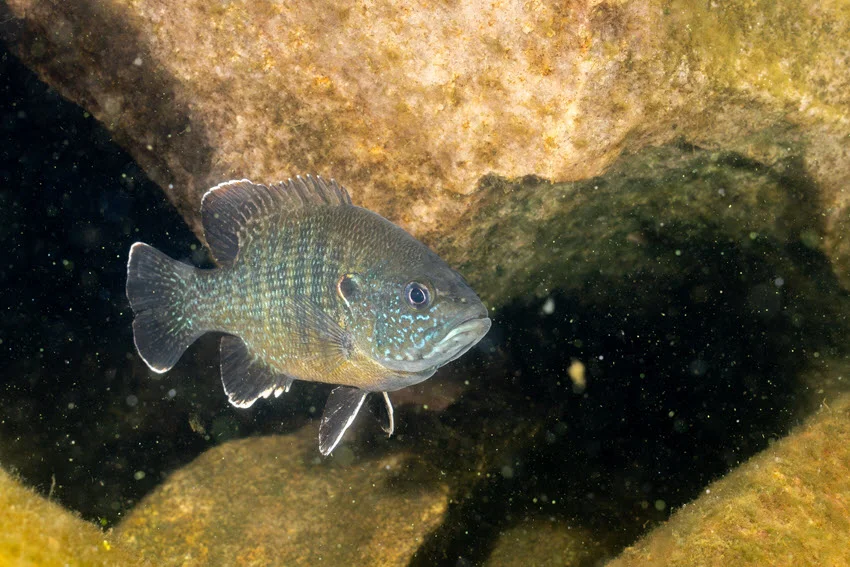
Green Sunfish have a deep, laterally compressed body and a noticeably large mouth, with the upper jaw often reaching to or past the middle of the eye. Their back is olive to brown, their sides are greener with small blue or emerald flecks, and the underside can look yellowish. A dark spot often shows near the rear of the dorsal or anal fin. The opercular flap is black with a lighter edge that may be yellow, orange, or white.
In terms of size, green Sunfish commonly grow to 3 to 7 inches in length, and often weigh less than 1 pound (usually much less) in many waters. In some favorable habitats, they may reach up to 12 inches and about 2.1 pounds, according to maximum records.
Green Sunfish prefer slow waters, ponds, small streams, the quiet backwaters of rivers, and the margins of lakes. They tolerate varied conditions. This type of Sunfish can survive in turbid, low-oxygen environments that might stress other Sunfish.
They often stay near cover. Try to find them around aquatic vegetation, fallen logs, submerged branches, or rocky edges. In the United States, Green Sunfish are widely distributed throughout the Midwest, South, and Great Plains, including states such as Illinois, Missouri, Kansas, Oklahoma, Texas, and Arkansas.
Peak biting often occurs during warmer months (spring through summer), when water temperatures are favorable for their feeding and spawning.
Green Sunfish are more active during these months, foraging aggressively near cover. In terms of daily timing, early morning and late afternoon are productive.
Light tackle is ideal, using ultralight or light spinning gear with line in the 2 and 6-lb test range. Use small hooks (size 10 to 14) to match their mouth size. A small float rig or light jig setup helps sense soft bites.
Ultralight rods and sensitive reels make it easier to feel subtle bites and enjoy the fight these small but feisty fish put up.
In shallow water (a few feet deep), live baits like worms, crickets, and small insects work well. Also, small soft plastics, micro jigs, or tiny spinners in shallow cover zones are effective. Because they often hug cover, presenting bait close to vegetation or structure helps.
Varying the size, color, and movement of your bait can increase your chances of enticing a bite from cautious Green Sunfish.
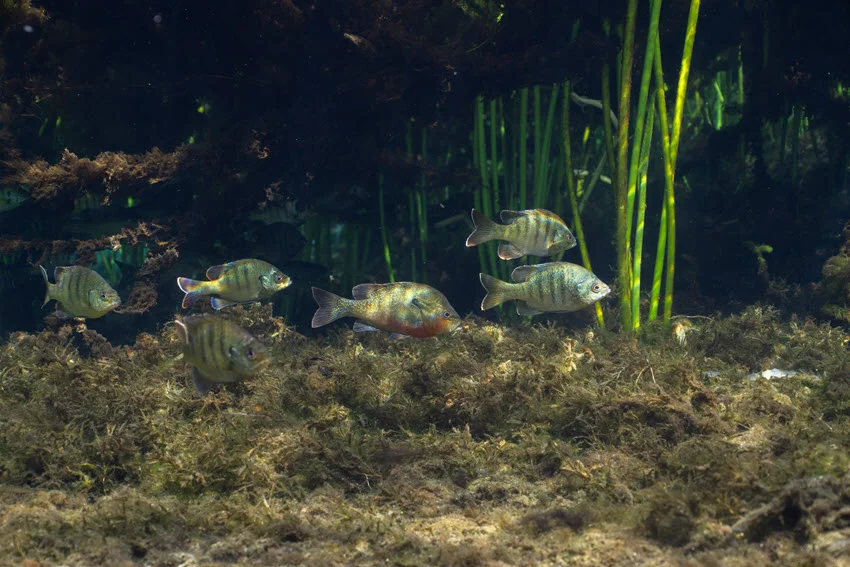
Redear Sunfish have a dark olive to green dorsal surface, yellowish-green sides with red or orange flecks, and a lighter belly. A distinctive red or cherry-orange margin exists on the opercular flap in many individuals, hence the name "Shellcracker" because they eat snails and mollusks.
In size, redear fish usually range from 7.9 to 9.4 inches and about 0.99 pounds in common adult specimens. The maximum recorded length is around 17 inches, and weights in the 5-pound range have been in trophy cases.
Redears often inhabit the deeper zones of ponds, lakes, reservoirs, and slow-moving rivers, particularly near the bottom substrates with mud or sand, close to vegetation or structural cover. They can be found at depths of 3 to 15 feet.
In the United States, they are especially common throughout the Southeast and Midwest (Florida, Georgia, Alabama, Mississippi, Tennessee, Kentucky, and Texas). They thrive in large bodies of water such as Lake Okeechobee, Kentucky Lake, Sam Rayburn Reservoir, and Santee Cooper Lakes.
The peak season coincides with the warmer months (late spring through summer), when mollusks are active, and fish forage energetically. Spawning also draws them into shallower zones during those periods.
Early morning and late afternoon are strong windows. During bright midday conditions, fish more slowly near deeper edges and bottom cover.
Use light to medium-light gear, a spinning rod, and 4 to 8-lb line. Use hooks that suit baits near the bottom (sizes 8 to 12). A small sinker or dropper helps get bait down to where they feed.
A sensitive reel and light rod tip make it easier to feel subtle bites when Redear Sunfish pick up your bait near the bottom.
Snail shells, small mollusks, or clam pieces are effective. Also, worms, small crustaceans, insect larvae, small soft plastics, or jigs close to the bottom near structure work well.
Present bait near the substrate, within a few feet of the bottom. Using a slow, steady presentation helps entice Redear Sunfish that may be feeding cautiously near cover.
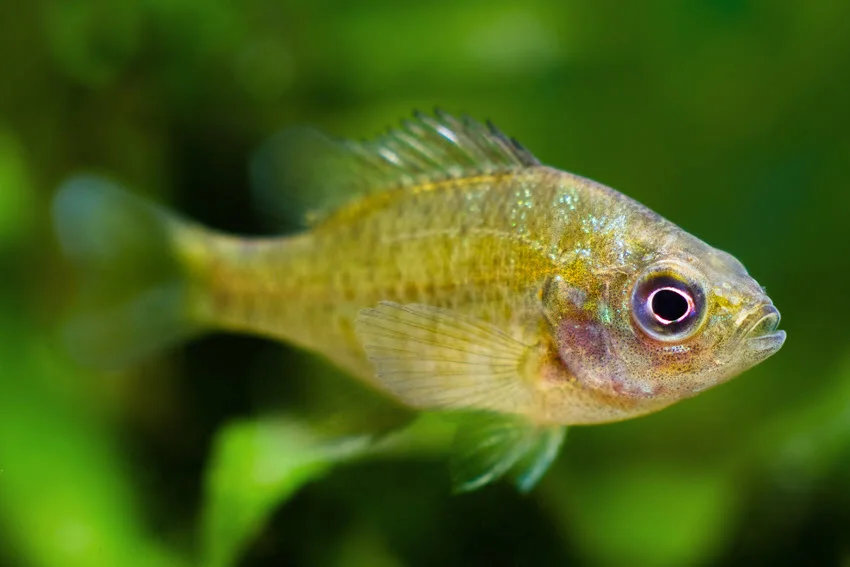
Redbreast Sunfish have a moderately deep body (less compressed than Bluegill), with a somewhat elongated profile. Their opercular flap is long and narrow, edged in light blue/white dorsally and ventrally, and black at the posterior edge.
During breeding, the breast and belly develop red or orange tones; the upper body is olive or greenish, fading to lighter green-blue on the sides. In size, redbreast Sunfish commonly reach 9.5 inches in length, and larger specimens are known. The all-tackle record is about 1.75 pounds.
Redbreast prefer habitats in rivers, creeks, and lake margins with rock or sandy bottoms, or vegetation. They often occupy moderate current zones or pools in streams, as well as the vegetated edges of lakes; this type of Sunfish swims at depths of 1 to 8 feet.
They are commonly found throughout the eastern and southeastern United States, particularly in the Atlantic coastal drainages from New York south through Florida, and westward into the Gulf states. Productive waters include rivers (Savannah, Suwannee, Altamaha, and St. Johns) and lakes (Lake Okeechobee in Florida, Lake Murray in South Carolina, and Watts Bar Lake in Tennessee).
Their spawning and peak feeding occur in spring to early summer (when water warms). During that time, they may be more aggressive and accessible.
As for the daily pattern, morning and evening are usually best; midday bites may require fishing in shade, deeper cover, or cooler zones.
Light spinning or ultralight gear works well, with 4 to 8-lb line and small hooks (size 8 to 14). Because Redbreast has a somewhat larger mouth than some smaller Sunfish, you have a bit more flexibility in bait size.
A balanced setup with a sensitive rod tip helps detect gentle bites, especially when fishing around structure or moderate currents.
Use live bait such as worms, crickets, aquatic insects, small crustaceans, or small soft plastics and jigs near submerged structure or along edges.
Because they forage among moderate current zones and structure, presenting baits near cover and edges is productive.
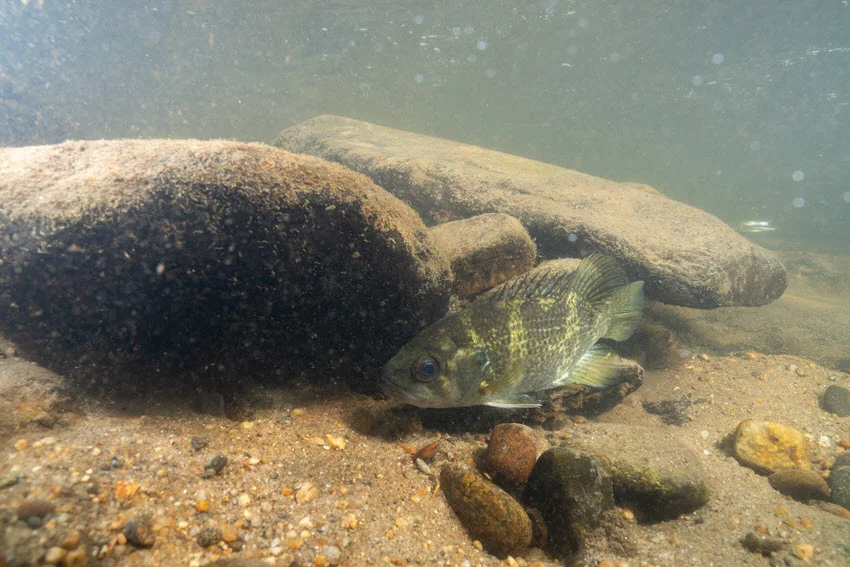
Warmouth are robust, thick-bodied Sunfish with a large mouth; the upper jaw often reaches or passes beyond the middle of the eye. Their coloration is mottled brown, olive, or dark, fading to yellowish on the belly. They typically have three spines in the anal fin and 9 to 11 dorsal spines; the tongue bears small teeth (a patch of teeth).
In size, warmouth commonly reach 4 to 10 inches in length, though some can grow over 12 inches. In weight, specimens up to 2.25 pounds have been reported. Records from some states show average sizes of 5 to 8 inches, with some specimens reaching up to 1.25 pounds.
Warmouths favor slow or still waters, such as swamps, ponds, lakes, backwaters, sluggish streams, and reservoirs, especially where the bottom substrate is mud or sand and vegetation or woody cover is present. Indicate average sizes of 5 to 8 inches, with some specimens reaching.
Warmouths could be found at depths between 1.3 and 7.2 feet in backwater habitats over muddy or silty bottoms. They are widespread in the midwestern United States (Florida, Georgia, Alabama, Mississippi, Louisiana, and Illinois). Popular locations are Lake Okeechobee, the Apalachicola River basin in Georgia and Florida, and Toledo Bend Reservoir on the Texas-Louisiana border.
Warmouth spawn beginning in late spring (May through July) when water temperatures rise, and males take up territory and guard nests.
They may be more active at dawn and dusk; midday may see them tucked deeper into cover or inactive zones.
Use light to medium-light gear; 4 to 8-lb line is suitable for most situations. Because Warmouth have a larger mouth, you have the flexibility to use somewhat larger baits or lures than for other Sunfish. Hooks in sizes 8 to 12 are often appropriate.
A small jig or soft plastic presented near structure works well for targeting these aggressive feeders. A sensitive rod helps you feel quick strikes, while a compact spinning reel gives better control when fishing close to cover or tight spaces.
The best baits for Warmouth are small soft plastics, crawfish imitations, minnow plugs, jigs, worms, or insect larvae around submerged logs, vegetation edges, or near stumps.
Slow-moving baits could also be very productive for this type of Sunfish. Because they lie in shallow cover, fish close to vegetation or cover edges. Presenting the bait tight to structure or letting it drop gently along weed lines could result in success.
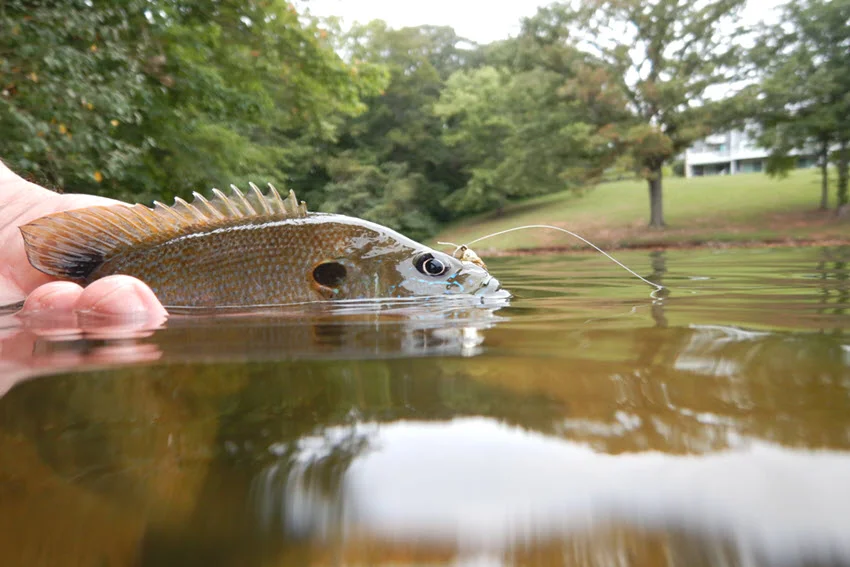
Sunfish are often caught with simple gear, but your success increases if you pay attention to subtle presentation. Use small hooks (for example, sizes 12 to 16) because Sunfish have small mouths, and a hook that is too large often results in missed bites.
Try fishing shallow near cover during the warm months. Sunfish often stay near weeds, logs, brush, or structural edges, especially in early morning when they move from deeper cover to feed.
Use a light line and sensitive setup, a small bobber or slip float, or a tiny jig. A lighter setup helps you detect subtle bites. Vary your method: start with a bobber and live bait (worms, crickets). If bites are slow, switch to jigs, small spinners, or flies.
Understanding fishing regulations and preserving specific fish species contributes to protecting fish populations and ecosystems and promoting responsible angling practices.
Anglers Booking Team
Fishing for Sunfish is generally safe and relaxing. However, it's still important to follow basic safety measures and local rules.
Before fishing, make sure you're ready for bad or unpredictable conditions. Below are safety points.
These basics go a long way toward staying safe, keeping your gear under control, and having a smooth day on the water, whether you are fishing from the bank, a kayak, or a boat.
Before targeting Sunfish, check your local and state fishing regulations. In the USA, Sunfish fishing is regulated by NOAA Fisheries and state authorities. Below, you can find some of the most important facts related to these regulations.
Respecting local fishing laws helps protect Sunfish populations and keeps the sport available for future generations. Always review the latest rules before you throw your line.
Sunfish are fun, colorful, and easy to catch. Catching this fish attracts a lot of beginners as well as experienced anglers. If you have carefully read this guide and if you apply the tips from it, there is no doubt that you are on the right track to a successful fishing day.
Which Sunfish species is your favorite to catch, and what tips have worked best for you? We'd love to hear your thoughts! Your tips might help other anglers enjoy Sunfish fishing even more.

The expert copywriters at Anglers Booking have meticulously crafted this article. Our dedicated team of writers provides valuable insights and information to enhance your angling experience.

April 25, 2026
November 28, 2025
Subscribe to our newsletter and receive a selection of cool articles every week.
Embark on unforgettable fishing adventures with us at Anglers Booking.
book your charter
October 2, 2026
September 8, 2026
August 21, 2026
August 18, 2026
August 15, 2026
August 12, 2026
August 8, 2026
August 4, 2026

You're now part of our exclusive community. Get ready for premium content and updates straight to your inbox.
close
Subscribe to our newsletter and receive a selection of cool articles every week.
Please enter a valid email address.
Be the first to know when we're back in action.
Please enter a valid email address.
Leave a Comment
Your email address will not be published. Required fields are marked *
Thank you for your comment! It has been submitted for review and will appear on the site shortly.