


Anglers Booking Team
The expert copywriters at Anglers Booking have meticulously crafted this article. Our dedicated team of writers provides valuable insights and information to enhance your angling experience.
 13 minutes read
Marlin are among the most spectacular and challenging fish to catch. They are part of a group of fish called "Billfishes." Sport anglers around the world prize Marlins. Knowing how many types of this fish there are, how to tell them apart, and how to target them will lead you to succeed.
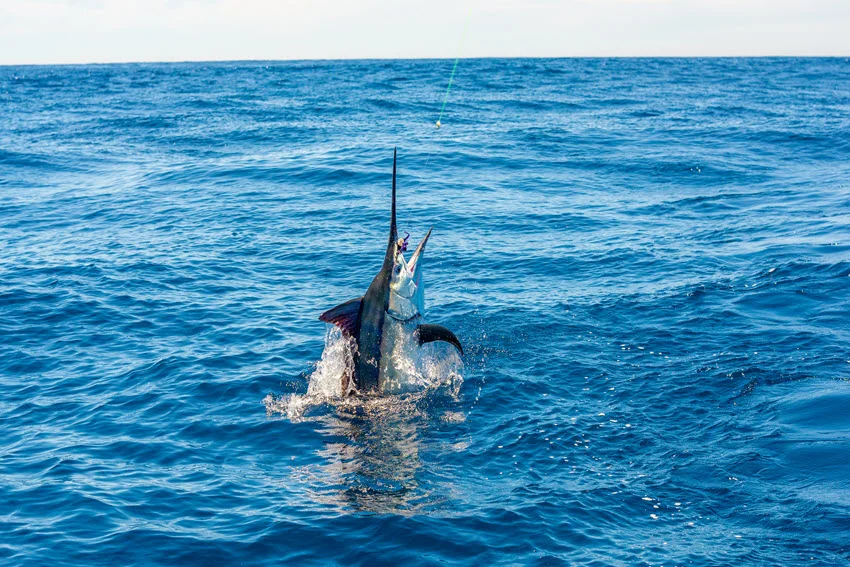
In the following, we will explain the types of Marlin and how to identify them. You will also find out how to catch them. Of course, that's not all. Read our guide to the very and learn all Marlins' secrets!
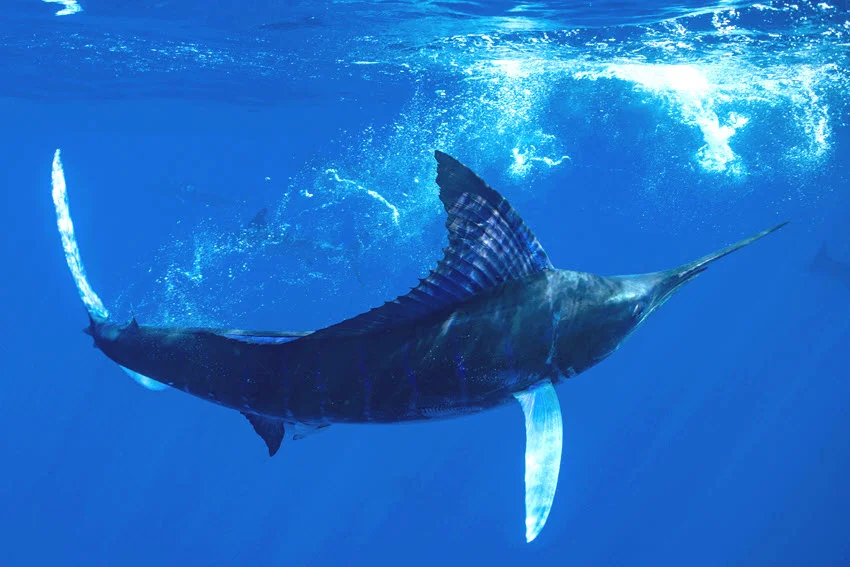
Marlins are known for their elongated bodies, a long "bill" or spear in the upper jaw. They have powerful swimming ability. Among the Marlin, anglers usually focus on four main species: Blue Marlin, Black Marlin, Striped Marlin, and White Marlin. These Marlin species differ not only in color and markings but in behavior, habitat, and size limits.
Each Marlin species behaves differently in the ocean. Some migrate long distances, others stay closer to reefs or drop-offs. They patrol ocean currents, weed lines, or temperature breaks, looking for schools of baitfish. Their feeding strategy involves slashing or stunning prey with the bill, then returning to eat the wounded fish. Marlin are also known to leap out of the water during fights.
Marlin attract anglers for several reasons. First, their sheer size and power make landing one a significant achievement. Second, species like Blue and Black Marlin are "trophy" fish that show up in offshore fishing tournaments. Third, because Marlin live in deep, open ocean, often far from shore, the logistics and planning needed to catch one also add to the thrill. Catching a Marlin is not so simple; it usually means a serious expedition.
In this section, we look at four of the most well-known Marlin species. For each species, we will provide a clear physical description, size ranges, where you can typically find them (depths, regions), the best time to catch them, recommended gear, and the types of bait that work best.
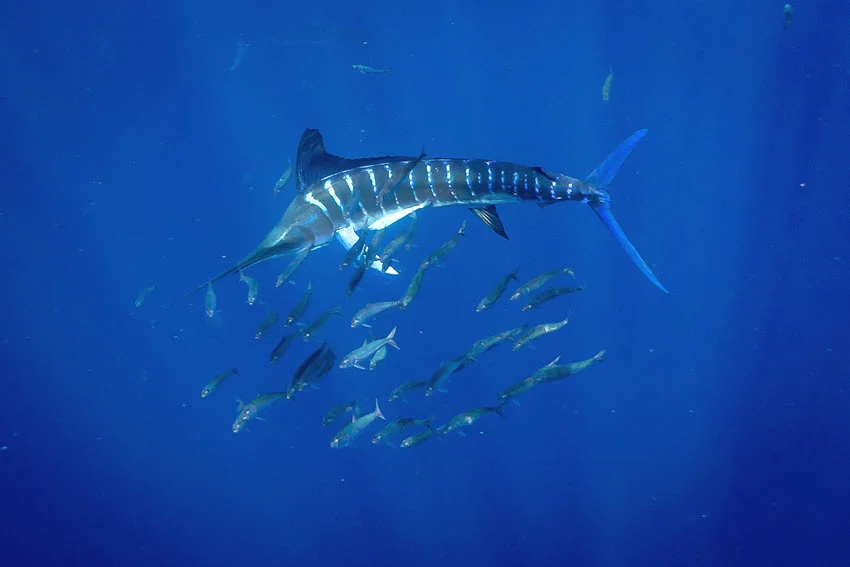
The Blue Marlin has a robust, elongated body, a pronounced dorsal fin, and a long, pointed bill. Its back is deep blue to cobalt, shading to silvery white on the lower sides and belly. In certain lighting conditions, vertical blue bars may appear faint on the sides. The dorsal fin is high and curved, and the pectoral fins are retractable. The body is muscular and designed for sustained speed in open water.
Females can reach approximately 168 inches in length and weigh over 1,985 pounds. Males are much smaller, often maxing out at 700 pounds. In typical sport catches, many Blue Marlin fall in the 200 to 500 pounds and 87 to 110 inches for length.
Blue Marlin swims in the waters of both the Atlantic and Pacific Oceans. They prefer open ocean environments, often far from coastlines and above deep drop-offs.
In terms of depth, Blue Marlin often roam in water depths between 300 and 600 feet when feeding or cruising.
In the Atlantic region, the Blue Marlin peak season runs from June to October, when the waters warm. In the Pacific, the best months are May through September.
During a given day, the early morning and late afternoon hours often offer the best bite rates, especially when temperature gradients, current lines, or bait concentrations are visible.
Because Blue Marlin are powerful and significant, you'll want heavy tackle. Rods in the 50 to 80-pound test class, paired with strong big game reels, are standard. Line capacity, drag strength, and durability are critical. Many anglers also use outriggers and spreads of trolling lines to present multiple baits. Setups often include heavy leaders and wire or stiff leaders to resist bill strikes. Because fights with Blue Marlin can last a long time, gear must endure prolonged stress.
Blue Marlin feed on pelagic fish, so trolled offerings like skipjack, mackerel, tuna strips, or artificial lures (skirts, plugs) are very effective.
These baits are often run at depths of 300 to 600 feet or shallower when fish move up to feed on schooling baitfish. Still, presenting the bait close to the strike zone is key.
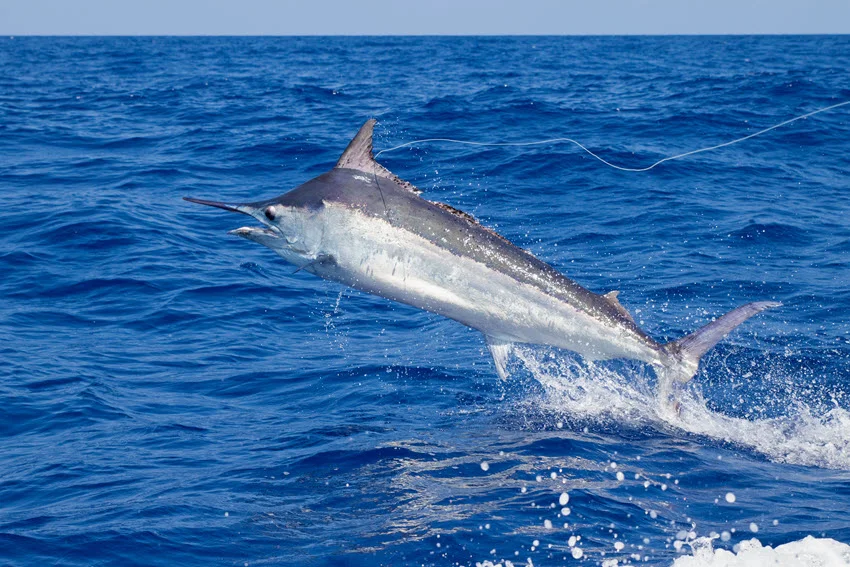
The Black Marlin has a stout, robust body. Compared to Blue Marlin, its bill is somewhat shorter and heavier. Its dorsal fin is very tall and rigid relative to its body depth, giving it a pronounced profile. The body coloration is a dark blue-black above, with a bright, reflective underside, sometimes separated by a pale stripe. One distinguishing feature: Black Marlin have rigid pectoral fins that cannot lie flat against the body when the fish grows large.
Black Marlin have been recorded reaching lengths over 180 inches and weights exceeding 1,600 pounds. However, many catches are in the 300 to 1,200-pound range for recreational anglers. The maximum published lengths are not always precise, but Black Marlin are among the largest of the Marlin species.
Black Marlin are found primarily in the Indo-Pacific region, including around Australia, Southeast Asia, and parts of Central America. They are often associated with reefs, drop-offs, and island slopes, but also roam the open ocean.
In terms of depth, Black Marlin are reliably caught around 100 feet in depth in many fisheries, though they are known to dive much deeper in open water.
In regions like Australia, the peak Black Marlin season runs from September through December. In Panama and parts of Central America, good times are from November to April. Within each day, midday to early afternoon, when the sun penetrates deeper, it can stimulate deeper feeding activity.
Early morning and late afternoon can also produce strikes when baitfish are on the move. Guides often vary presentation times depending on local conditions.
Given the strength of Black Marlin, heavy tackle is also essential. Many anglers use 50 to 80-pound or even 130-pound class gear. Reels with high drag capacity, good line capacity, and strong frames are imperative. Leaders often run a 300-500 lb test, sometimes with wire.
Strong rods with a high backbone are needed to control long runs and substantial leaps. Many Black Marlin are caught while trolling multiple lines behind outriggers.
Black Marlin respond well to large live baits such as bonito, small tuna, or skipjack. Big trolling lures (skirts, plugs) are also effective, especially when fish are more aggressive.
These bait presentations often occur in the upper water column, sometimes within 100 to 200 feet of the surface, when Marlin are patrolling structure edges or drop-offs.
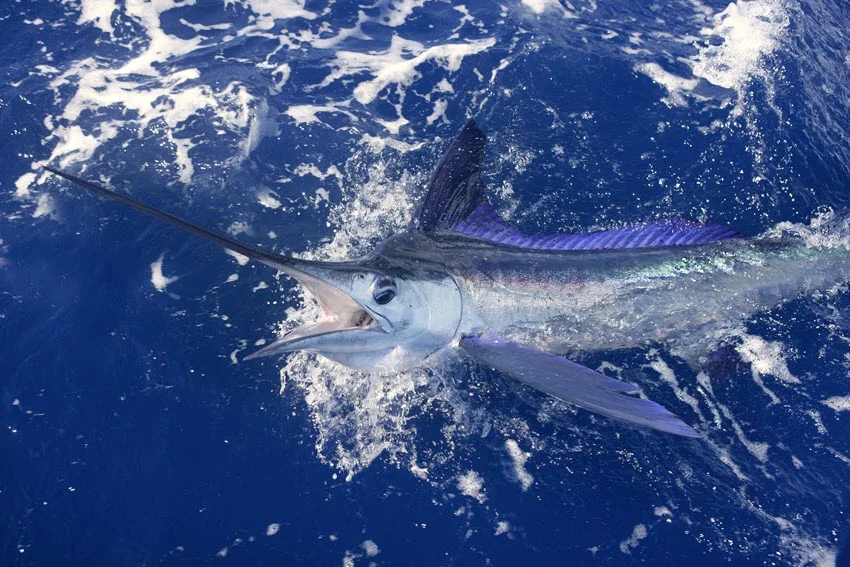
The White Marlin is more lightly built than other Marlin species. Its fins (dorsal and anal) are relatively rounded rather than sharply pointed. It has a more streamlined body, with its upper body blue and transitioning to a white or silvery underside.
The bill is long but more slender relative to body size. Because it is smaller, its body shape appears more delicate than that of the Blue or Black Marlin. Most Black Marlin measure 60 to 108 inches. Average weights are 50 to 100 pounds, though the maximum recorded weight is around 220 pounds.
Black Marlin live in the tropical and subtropical Atlantic Ocean. They often stay near the surface or in the upper waters above 330 feet, and can be found near banks, shoals, or canyon edges where baitfish gather.
Their usual depth range is shallower than that of many Marlin species. Black Marlins are common near the surface and rarely venture deeply.
The peak season is June through September along the U.S. East Coast, the Gulf of Mexico, and the Caribbean.
Within a day, morning and late afternoon periods tend to be most productive, especially when baitfish move closer to the surface.
Because Black Marlin are smaller, medium to heavy-tackle is often used. Still, the gear must be reliable, with good drag and smooth performance, because even a Black Marlin can make surprising runs.
Leaders of 100 to 300-pound test are standard, often fluorocarbon or mono, and many anglers use light wire or shock tippets.
Black Marlin feed on small pelagic species like sardines, squid, and small baitfish. Trolling small skirted lures, plugs, rigged baits, or natural baits close to the surface is very effective.
Because they feed near the surface, bait presentations are often in shallow depths or near the surface, much shallower than many deep-water Marlin species.
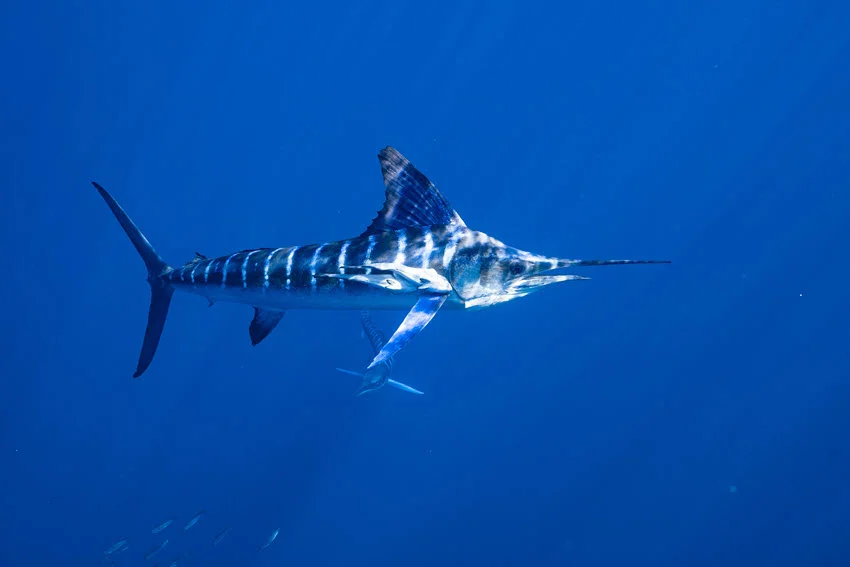
The Striped Marlin has an elongated, torpedo-like body with a dark blue to black top and silvery underside. A key characteristic is its vivid, vertical, blueish stripes (12 to 20 or more) on the sides, which remain visible even after the fish is dead. Its dorsal fin is tall (often as tall as or taller than body depth), and the pectoral fins are non-retractable. The body is slender and built for speed, with a moderately long bill.
Striped Marlin can reach up to 144 inches in length and more than 450 pounds in weight. Striped Marlin are more commonly 120 to 250 pounds and 78 to 120 inches long.
Striped Marlin are primarily found in the tropical to temperate waters of the Pacific and Indian Oceans, often in open water near the surface. They are epipelagic, meaning they tend to stay in the upper layers of the ocean (at a depth of 330 feet).
They often follow seasonal migrations and can be found near fronts, weed lines, and baitfish concentrations.
In areas like Baja California and New Zealand, peak season is November to March. In Ecuador and Peru, December to May is often prime time.
Within a day, midday to early afternoon often sees good activity, primarily when water heating and currents concentrate bait. Also, early morning periods can be productive.
Because Striped Marlin are smaller, many anglers use 30 to 80-pound class gear, depending on local size norms. Reels should still be durable, smooth, and have good drag. Leaders of 200 to 400 pounds are common in many Striped Marlin fisheries.
Light but strong rods with a fast action help set hooks quickly on aggressive strikes. Trolling spreads with multiple lines is standard.
Striped Marlin feed on sardines, anchovies, squid, and small mackerel. Fast, small, flashy lures trolled near the surface that mimic schools of baitfish are effective.
Because this type of Marlin feeds in shallow to moderate depths, baits are often placed within 100 to 300 feet of depth.
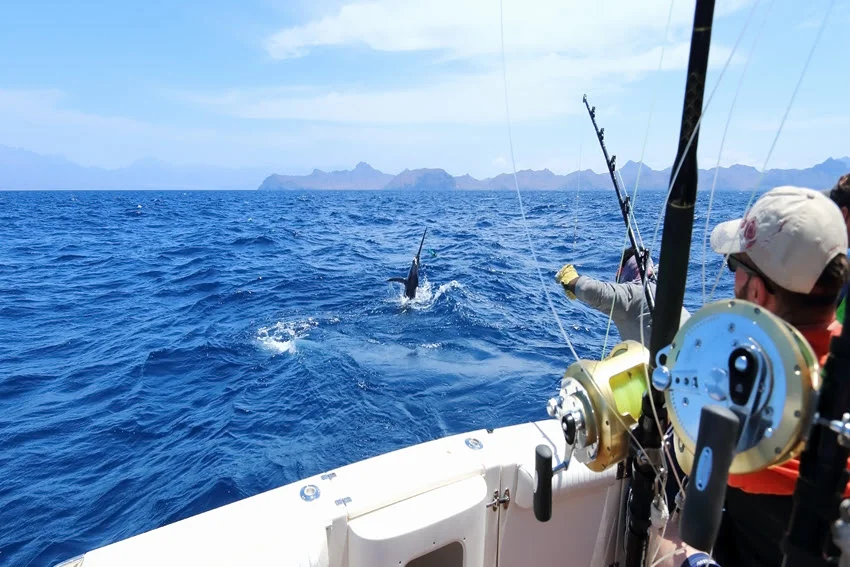
When targeting Marlin, patience is key as they are not always easy to find, and anglers often spend hours searching offshore before finding them. Keeping a close eye on ocean conditions and currents can help you locate areas where Marlin are most likely to be feeding.
Boat handling makes a big difference once a Marlin is hooked. Because these fish are strong, the captain must carefully maneuver the boat. This will help the angler keep line tension and avoid breakoffs. Quick reactions can prevent the line from rubbing against the boat.
Another tip is to vary trolling speeds and lure spreads. Marlin often respond to movement and flash, so changing the pattern of baits or adjusting the speed slightly can trigger a strike.
If you want to release Marlin after catching it, let's do it safely by keeping it out of the water briefly. Practicing catch-and-release is very important for fish species.
Understanding fishing regulations and preserving specific fish species contributes to protecting fish populations and ecosystems and promoting responsible angling practices.
Anglers Booking Team
Targeting Marlin can be both challenging and exciting, but it can also be risky because of their powerful fight and unpredictable behavior. We have added more details on this topic, and it should be one of the first things you keep in mind before heading out on your next adventure.
Open water can be unpredictable and dangerous, especially when targeting fast, powerful fish. Below are a few essential safety tips to help you stay prepared and avoid common mistakes.
Be properly prepared before you head out fishing, and stay alert the entire time on the water. Taking a cautious approach, following basic safety practices, and using the right gear can significantly reduce risk at sea.
Conservation plays a significant role in Marlin fishing. Many countries, including Florida's FWC, have regulations to protect Marlin populations, and anglers should always be aware of these before fishing.
By complying with regulations, anglers help protect Marlin for the future, ensuring this iconic sport fish remains available for generations of ocean lovers.
Marlin fishing provides exceptional experiences in sport angling. Learning the differences between Blue, Black, White, and Striped Marlin and where and when to find them will lead you to fishing success.
With the right gear, patience, and knowledge of regulations, every angler can enjoy responsible fishing for Marlin. However, safety and conservation are essential parts of the offshore fishery. The ocean offers adventure, but it also demands respect.
What about you? Have you ever tried Marlin fishing, or is it still on your bucket list? We are happy to see your answers in the comments below.

The expert copywriters at Anglers Booking have meticulously crafted this article. Our dedicated team of writers provides valuable insights and information to enhance your angling experience.

September 5, 2025
Subscribe to our newsletter and receive a selection of cool articles every week.
Embark on unforgettable fishing adventures with us at Anglers Booking.
book your charter
September 8, 2026
August 21, 2026
August 18, 2026
August 15, 2026
August 12, 2026
August 8, 2026
August 4, 2026
April 17, 2026

You're now part of our exclusive community. Get ready for premium content and updates straight to your inbox.
close
Subscribe to our newsletter and receive a selection of cool articles every week.
Please enter a valid email address.
Be the first to know when we're back in action.
Please enter a valid email address.

Leave a Comment
Your email address will not be published. Required fields are marked *
Thank you for your comment! It has been submitted for review and will appear on the site shortly.