


Anglers Booking Team
The expert copywriters at Anglers Booking have meticulously crafted this article. Our dedicated team of writers provides valuable insights and information to enhance your angling experience.
 11 minutes read
The world beneath the ocean's surface is home to a diverse range of creatures, some stunning in their beauty. However, many dangerous creatures inhabit these waters.
From sharp-toothed predators to venomous creatures with dangerous spines, these sea beasts are known for their aggressive behavior towards humans.

These fish are notorious for being some of the most dangerous creatures lurking beneath the water's surface. Although sharks are often the first type of fish that comes to mind, it's important to note that other types of fish can also be fatal to humans.
Below, we explore a few of the most dangerous fish for humans. We will describe their characteristics in detail, explain the dangers they present, and explain why they have fantastic status. Be sure to stay with us until the end; we are afraid to go through this adventure alone!
We won't keep you in suspense for long. In the next part, we list and describe in detail the types of fish dangerous to humans.

The first is, of course, the shark. Does it make sense to explain why it is in the first place? Well, sharks are undoubtedly a symbol of sea danger for humans.
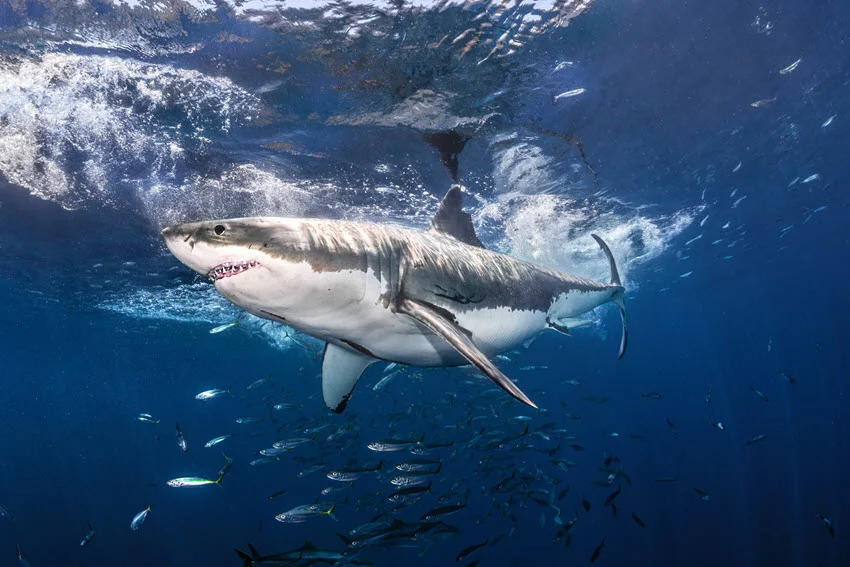
When discussing sharks as a threat to humans, we must single out the Great White Shark. This shark is a symbol of strength and one of the largest living predators. It also became the star of many films and documentaries.
With its sharp teeth, this large marine predator is considered one of the most dangerous fish for humans. Although Great White Shark attacks on humans are not as frequent as in the movies, when they do happen, they are usually fatal. Their size, speed, and strength make them relentless ocean predators. It is important to understand their behavior and avoid areas where they are known to be active hunters. In this way, the risk of meeting them will be reduced.
The Great White Shark hunts its prey with impressive precision and speed. Its powerful jaws allow it to easily bite through the flesh of its prey, including humans. Survival may depend on a quick and deliberate response for those under attack. Therefore, swimmers and divers must be informed about safety measures and protocols in the event of an encounter with this powerful predator.
The Great White Shark can grow to impressive dimensions. Adult specimens can reach a length of 12 to 20 feet and a weight of 1,100 to 2,200 pounds.
One of the famous examples of a Great White Shark attack on a human happened in 1916. Within just a few days, four attacks occurred along the New Jersey coast. These attackers took as many as five human lives. These attacks inspired the novel White Shark (Jaws). Based on this novel, Steven Spielberg later made a famous movie.
Although the Great White Shark is often the focus of attention, other shark species are also known to attack humans. For example, when comparing the Tiger Shark vs. Great White, we can say that both sharks are responsible for attacks.
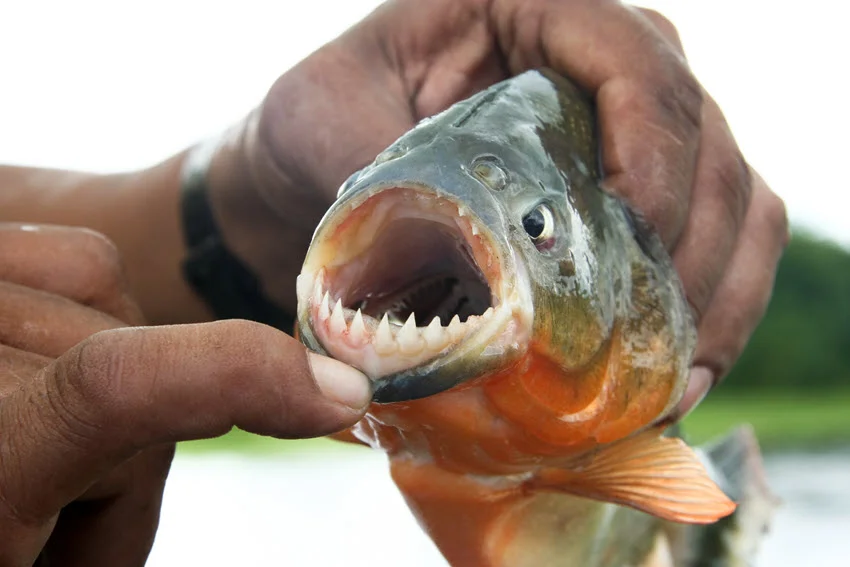
The Piranha Fish is known for its sharp teeth. It is characterized by very aggressive behavior. It often causes fear among people who explore the tropical waters of South America. Piranha attacks on humans are rare.
However, these small but fierce predators can cause serious injury when in a flock or starving. Piranhas are known for their ability to gather around their prey quickly and suddenly stretch it. Only the bones of their prey remain behind them. Avoiding areas where Piranhas live or taking precautions can help prevent unwanted encounters with these predators.
Piranhas live in the rivers and lakes of South America. Although many myths about their aggressiveness exist, Piranhas often avoid conflict with humans. However, under certain circumstances, such as starvation or threats to their territory, they can become aggressive and attack humans or other animals.
The dimensions of Piranhas vary. Most adults are 6 to 10 inches long and weigh about 2 to 4 pounds. Although small compared to other dangerous fish, their teeth can cause serious injuries. They are especially dangerous when they are in a flock.
In 2011, there was a notorious incident of Piranha attacks on a group of swimmers in Brazil. Despite all the swimmers surviving the attack, some of them sustained severe injuries. This incident serves as a reminder of the significance of taking necessary precautions while swimming in such areas.

The Oyster Fish, also known as Stonefish, is considered one of the most dangerous fish in tropical and temperate waters. Its camouflage is so perfect that it can blend in with its surroundings, making it difficult to spot. The fish's spines are highly poisonous and can cause serious injury to humans who accidentally come into contact with them.
Stonefish are commonly found near reefs or rocky shores. They have a rough texture that resembles rocks or sand. The spines on their backs are connected to a poison gland, which can be used as a weapon for self-defense. Treading carefully when walking on the seabed is important to avoid accidentally stepping on a Stonefish and getting injured.
The size of Oyster Fish varies, but most adults measure 12 to 20 inches in length.
During the summer of 2018, a group of tourists diving in the tropical waters of Thailand had an unpleasant encounter with an oyster fish. One of the tourists accidentally touched a fish while exploring the coral reef. This caused a sudden attack. The Oyster Fish pierced the tourist's foot with its poisonous spines. Fortunately, the diving guide's quick response and immediate medical intervention prevented further complications.

Goliath Tigerfish, also known as Hydrocynus goliath, is one of the largest and most dangerous species of freshwater fish in the rivers of Africa. This imposing fish stands out for its sharp teeth and aggressive behavior.
It is a serious threat to other fish and even to humans. It can quickly hunt prey. Goliath Tigerfish is a top predator. Although attacks on humans are rare, this fish can cause serious injury if you get in the way of this predator.
Goliath Tigerfish live in the rivers and lakes of Central and West Africa. Adults can reach an impressive length of 5 to 6 feet and weigh over 150 pounds.
There are documented incidents of people being attacked. For example, while fishing in the Congo River, some fishermen have experienced attacks by this fish. It happened while they were trying to get the catch out of the water.
In such situations, the Goliath Tigerfish can inflict severe injuries with its sharp teeth. This imposing fish is dangerous and one of the most scary creatures. It fascinates and frightens people.

There is a fish in a pond that stands out from the others. This fish is a Pufferfish, and unlike other fish, it cannot eat humans. However, it is still very dangerous to humans due to its poisonous flesh.
The Pufferfish, also known as the Drowning Fish, has a distinct appearance. It can protect itself from predators by inflating its body, making it difficult to swallow or attack. The main danger of this fish lies in its liver. The liver contains a potent neurotoxin that can be fatal to humans. Preparing this fish requires specialized chefs trained to remove the poisonous parts of the flesh.
While incidents of fish poisoning by drowning are rare, documented cases demonstrate that people are sometimes put at risk. For instance, cases of fugu poisoning are reported annually in Japan, which is mainly caused by improper food preparation. The consumption of uncooked fish liver can also lead to such incidents.

Electric eels are potentially dangerous. They are found in the waters of South America. Although they are called eels, they are a type of leg fish. Electric eels are known for their ability to generate powerful electric shocks.
These strikes are used both for hunting and for self-defense. They can cause shocks as high as 600 volts, which can cause significant damage or even death if not treated in time.
The Electric Eel lives in fresh waters along the Amazon and Orinoco basins. Its electric organs are used mainly to navigate murky waters and find prey. When threatened, the eel can perform high-voltage electrical discharges to defend itself.
These extraordinary animals can reach a length of over 8.2 feet and a weight of up to 44 pounds. Although they have a fearsome reputation, they usually only strike if provoked or feel threatened.
Encounters with Electric Eels are rare. However, incidents of accidental strikes were recorded. These impacts cause pain. In some cases, it leads to death. Therefore, be careful.
In 2019, a fisherman from Brazil was attacked by an eel while fishing in one of the river courses in the Amazon. The attack caused serious injuries, and the fisherman had to be transported to the hospital for treatment.

Morey Eel, also known as Muraena, is a type of sea fish known for its long and slender figure and impressive set of teeth. Although these fish are fascinating to watch, they can pose a danger to humans. They are dangerous mainly if they are not appropriately treated or irritated.
Moray eels are nocturnal predators that feed on other fish and crustaceans. They usually hide in coral reef crevices in warm and moderately warm marine waters. They can become aggressive if they feel threatened.
The dimensions of the Moray Eels are different. Most can reach a length of 3 to 6.5 feet.
One instance of a Moray Eel attack on humans occurred in Hawaii in 2017, when a diver carelessly touched the Moray Eel hiding in the reef's crevice, resulting in injury.

Candiru, also known as Vandellia Cirrosa, is a small fish that lives in the rivers of South America, especially in the basins of the Amazon. This fish is known for its parasitic nature and for attacking people. Candiru fish attacks can be excruciating.
The Candiru is a type of fish that mainly feeds on the blood of other fish. However, it has also been known to feed on human blood. Its attack mode involves swimming into body openings like the mouth or other orifices. Once inside the body, the fish lodges itself with its sharp spines, causing serious injuries such as bleeding and infections.
The dimensions of candiru fish are usually small. They do not exceed a few inches in length. Although small, their ability makes them a significant threat to human swimmers.
One of the famous cases of candiru fish attacks happened in 1997 in the Amazon River. A group of swimmers were swimming in the river when several candiru fish entered their bodies through their mouths. These incidents caused panic and trauma among the victims, and several of them had to seek medical attention. Although candiru fish attacks are rare, it is important to be careful.

Red Lionfish is a well-known exotic fish that originates from tropical and moderately warm waters. It is recognized by its fan-shaped red fins.
The Red Lionfish is known for its defensive behavior and can cause serious injury if challenged or threatened. Its spines contain poisonous substances that can cause pain, swelling, and even paralysis in humans. When the fish is disturbed, these spines can be activated, making it dangerous for humans and other fish in its environment.
The Red Lionfish inhabits coral reefs and rocky areas. It feeds on smaller fish and crustaceans. Although attacks on humans are rare, the Red Lionfish can become aggressive if threatened.
The dimensions of the Red Lionfish vary. Adults usually reach a length of 0.98 to 1.25 feet. One example of a Red Lionfish attack on a human happened in 2015 in Hawaii. A diver carelessly touched a fish while diving in coral reefs. The blows from the poisonous spines caused severe pain and swelling in the diver, who was forced to seek medical intervention.
We hope that our overview of the most dangerous fish was constructive. We aimed to raise awareness about the potential dangers in waters worldwide. Even though encounters with these perilous fish are uncommon, it is essential to be aware of their presence and take necessary precautions while in the water.
Gaining knowledge about the behavior of these fish can decrease the risk of an incident. We hope you found this information helpful and will take the necessary steps to stay safe while enjoying the water.

The expert copywriters at Anglers Booking have meticulously crafted this article. Our dedicated team of writers provides valuable insights and information to enhance your angling experience.
October 10, 2025
July 25, 2025
Subscribe to our newsletter and receive a selection of cool articles every week.
Embark on unforgettable fishing adventures with us at Anglers Booking.
book your charter
October 2, 2026
September 8, 2026
August 21, 2026
August 18, 2026
August 15, 2026
August 12, 2026
August 8, 2026
August 4, 2026

You're now part of our exclusive community. Get ready for premium content and updates straight to your inbox.
close
Subscribe to our newsletter and receive a selection of cool articles every week.
Please enter a valid email address.
Be the first to know when we're back in action.
Please enter a valid email address.
Leave a Comment
Your email address will not be published. Required fields are marked *
Thank you for your comment! It has been submitted for review and will appear on the site shortly.